A website that explains delivery software as fast as it dispatches
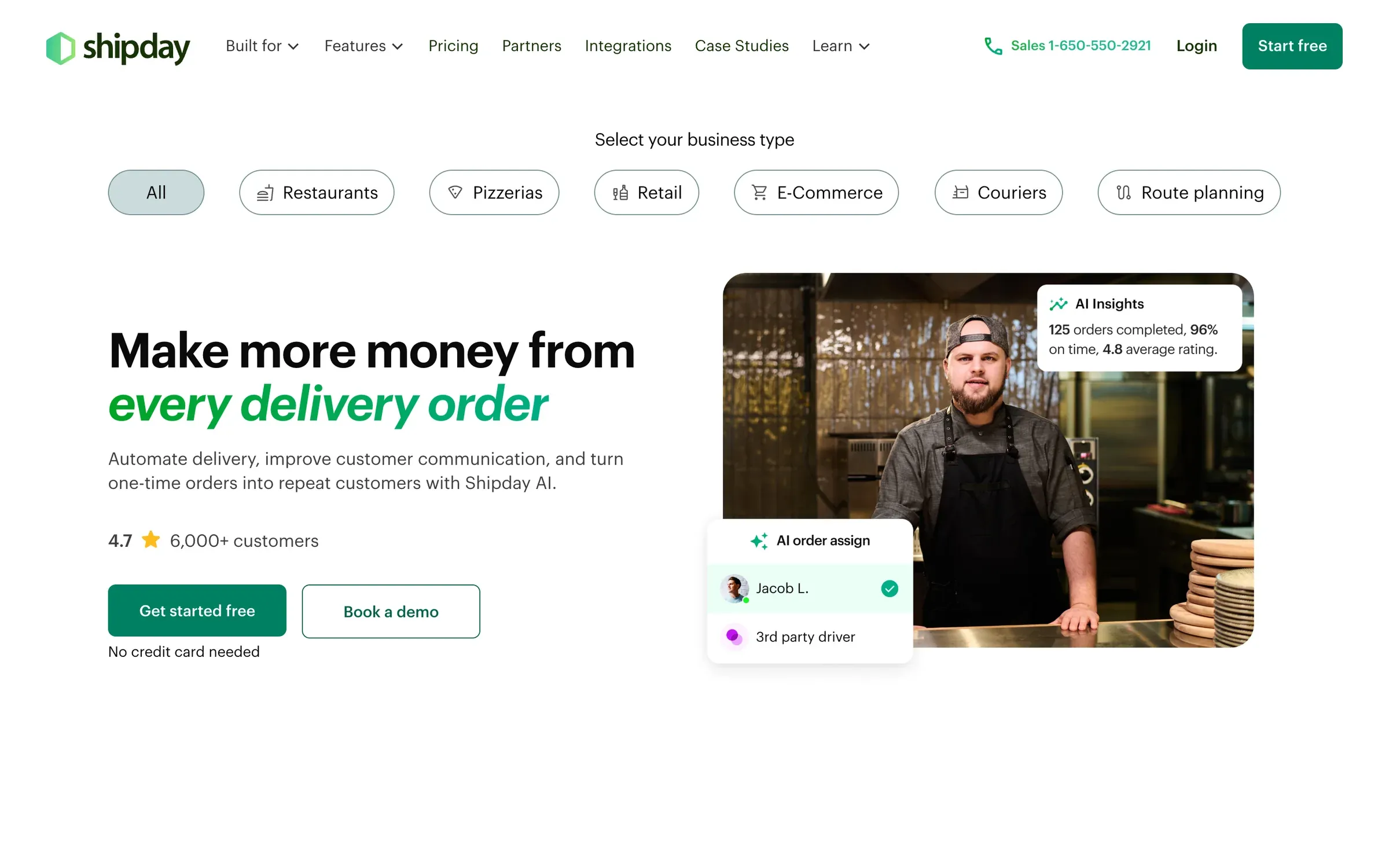
Shipday helps restaurants and local businesses run their own deliveries. I designed and built its website in Webflow, from the home page to the feature pages and a full integrations directory.
40%
more free-trial signups
after the relaunch
30+
integration pages
generated from one CMS template
95
Lighthouse score
on the home page
01
The client
Shipday is a US delivery management platform for restaurants, grocers and local businesses. It covers dispatch, live tracking, a driver app, on-demand third-party drivers and AI order assignment, so a business can run its own delivery instead of paying marketplace fees. The work came through Effiqs.
02
The challenge
Shipday's buyers are restaurant owners, not software people. They land on the site between services and need to understand in seconds what it does and whether it works with the tools they already use. The product had grown into a long list of features and integrations, and the site had to show all of it without turning into a spec sheet.
03
The process
Structure first, because the site's real job was helping people find their own use case fast.
- 01Sitemap. Home, a page per core feature and an integrations directory as the backbone.
- 02Home page. One message up top: AI-powered delivery management and customer experience.
- 03Feature pages. A shared template for real-time tracking, custom branding and ads, automated dispatch and the driver app.
- 04Integrations directory. A CMS-driven catalog, so a new integration is a new entry, not a new page design.
- 05Webflow build. Designed and developed in Webflow so marketing could publish on its own.
04
The solution
The home page leads with the promise and moves straight to proof: the dashboard, the tracking screen and the driver app, shown as they actually look. Each feature page follows the same rhythm, from problem to screen to result, so a visitor who reads one knows how to read them all.
The integrations directory does a lot of quiet selling. A restaurant on Toast or a shop on Shopify, WooCommerce, Squarespace, Wix or GrubHub can find its platform, see how the connection works and start a trial from that page. It's built as a Webflow CMS collection, so the list grows without a designer.
05
Results
Shipday got a site that answers an owner's first two questions (what does it do, and does it work with my setup) before they scroll far.
Marketing now adds features and integrations on its own. The design holds because the templates were built for it, not patched afterward.
40%
more free-trial signups
after the relaunch